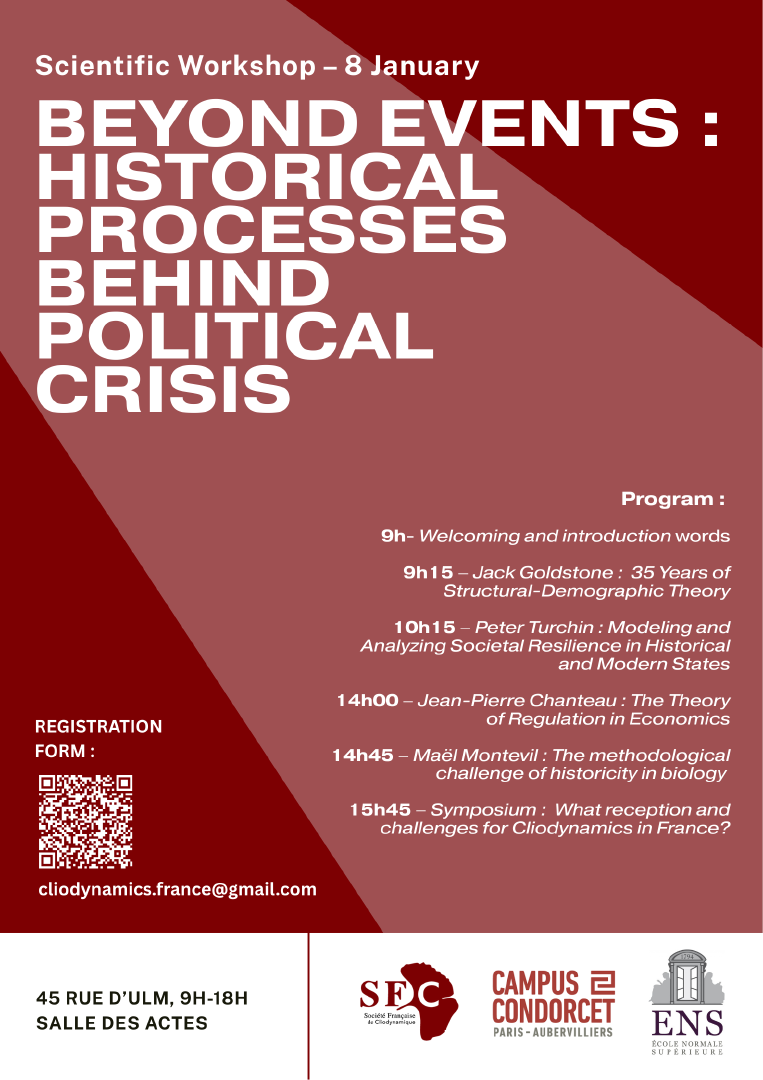
This scientific workshop is organized the Société Française de Cliodynamique, Campus Condorcet and École normale supérieure (ENS).
le 8 janvier 2026
Today, an increasing number of transdisciplinary studies, bringing together sociology, history, ecology, economics, and political science, adopt this long-term perspective to analyze political crises. Advances in computational methods and the development of large-scale databases now make it possible to examine numerous cases simultaneously, to enhance comparative analysis, and to empirically test competing hypotheses. Despite the limitations inherent in any process of standardization, these approaches contribute to the development of more robust theoretical frameworks by articulating quantitative and qualitative analyses.
Improving our understanding of the emergence of political instability is essential to formulating more appropriate and sustainable responses. This workshop aims to take stock of current research on the historical and structural origins of political crises and to foster the emergence of a European and interdisciplinary research community dedicated to these questions.
Provisional Program
- 9h- Welcoming and introduction words
- 9h15 – Jack Goldstone – 35 Years of Structural-Demographic Theory
- 10h30 – Peter Turchin – Modeling and Analyzing Societal Resilience in Historical and Modern States
- 14h00 – Jean-Pierre Chanteau – The Theory of Regulation in Economics
- 14h45 – Maël Montevil – The methodological challenge of historicity in biology
- 15h30 – Table ronde – What Reception and Challenges for Cliodynamics in France? Animé par Pierre-Paul Zalio avec la participation de Jean-Pierre Nadal, Nicolas Salerno et Nicolas Sauger.